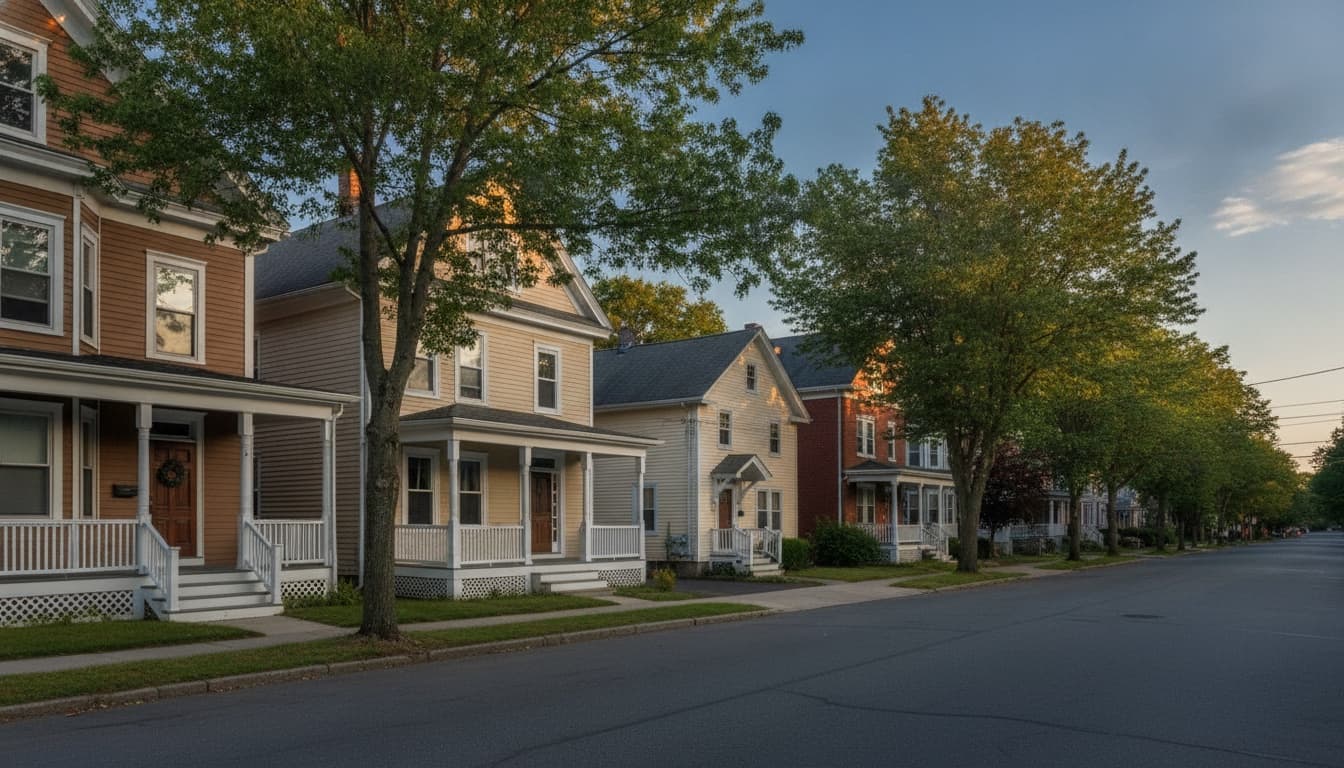
Are you sitting on more home equity than you realize? If you own a home in Worcester County, there's a good chance you are. The average home value across the county has reached $496,081, according to Zillow, with values climbing roughly 2.9% over the past year. For homeowners who've been paying down a mortgage for several years — or who bought before the market's recent run-up — that growth translates into borrowing power. A home equity loan lets you convert a portion of that value into cash, with a fixed rate and a predictable repayment schedule.
A home equity loan is a type of second mortgage. You borrow a lump sum against the equity you've built in your home, then repay it in fixed monthly installments over a set term — typically 5 to 30 years. The interest rate stays the same for the life of the loan, so your monthly payment won't change.
Your equity is the difference between what your home is worth and what you still owe. Let's say your Worcester County home appraises at $480,000 and you owe $280,000 on your first mortgage. That gives you $200,000 in equity. Most lenders require you to keep at least 15% to 20% equity after the loan, so you could potentially borrow up to $104,000, depending on the lender's CLTV limit.
The funds arrive as a single disbursement at closing, and you're free to use them however you choose — renovations, debt consolidation, tuition, medical expenses. Your home serves as collateral, which is why rates run well below credit cards or personal loans. That same arrangement means falling behind on payments could put your home at risk.
Lenders evaluate several factors before approving a home equity loan. While exact thresholds vary, here's what most will expect:
At least 15% to 20% equity in your home. Lenders calculate your CLTV ratio by adding your existing mortgage balance to the proposed loan, then dividing by your home's appraised value. Most cap the CLTV at 80% to 85%, according to Bankrate.
A credit score of 620 or higher. That's the floor for many lenders, though a score of 740 or above earns you meaningfully lower rates. Per LendEDU, the difference between a 760 and a 640 score on a $50,000 loan could mean roughly $17,000 more in total interest.
A debt-to-income ratio below 43%. Some lenders allow ratios up to 50%, but a lower ratio strengthens your application.
Stable, verifiable income. Expect to provide pay stubs, W-2s, and tax returns covering the past two years.
A property appraisal. The lender will order one to confirm your home's value. Costs typically run $300 to $500.
Home equity loan rates have been trending downward since late 2024, and they're now near three-year lows. The national average sits at approximately 7.89% for a 5-year term and 8.06% for a 15-year term, according to Bankrate's February 2026 survey. Some borrowers are seeing offers closer to 7% or below, depending on creditworthiness and lender.
Ted Rossman, Bankrate's senior industry analyst, forecasts home equity loan rates to average around 7.75% through 2026, with further modest declines possible if the Federal Reserve continues cutting its benchmark rate. Three additional quarter-point cuts are widely expected this year, per Bankrate's rate forecast.
Your individual rate depends heavily on your credit profile. Borrowers with scores above 740 tend to qualify for rates at the lower end of the range, while those in the 620 to 679 tier may see offers 2 to 4 percentage points higher, according to The Mortgage Reports.
Home equity loans come with closing costs, similar to a primary mortgage but usually smaller in scale. Plan on paying between 2% and 5% of your loan amount in upfront fees, according to Bankrate. On a $75,000 loan, that works out to somewhere between $1,500 and $3,750.
Here's what those fees typically cover: origination fees (0.5% to 1% of the loan amount), appraisal fees ($300 to $500), title search and insurance, credit report fees ($30 to $120), attorney and document preparation fees ($100 to $500), and recording fees ($15 to $50).
Some lenders advertise no-closing-cost home equity loans, but those typically roll the fees into a higher interest rate. Over the life of a 15- or 20-year loan, that tradeoff can cost more than paying the fees upfront.
The rules around deducting home equity loan interest depend on how you use the funds. Under the Tax Cuts and Jobs Act provisions — now made permanent by the One Big Beautiful Bill Act signed in July 2025 — you can deduct interest on home equity debt only if the proceeds are used to buy, build, or substantially improve the home that secures the loan, per the IRS. Using a home equity loan for credit card payoff, tuition, or a vacation won't qualify.
There's also a cap. You can deduct interest on up to $750,000 of total mortgage debt — your primary mortgage and home equity loans combined — if you file jointly, or $375,000 if you file separately. For mortgages taken out before December 16, 2017, the higher $1 million limit still applies under a grandfather provision.
To benefit from this deduction, you'll need to itemize rather than take the standard deduction. For the 2025 tax year, the standard deduction is $15,750 for single filers and $31,500 for married couples filing jointly. If your total itemized deductions don't exceed those figures, the interest deduction won't provide additional tax benefit.
A home equity line of credit (HELOC) is the other main way to borrow against your equity. While a home equity loan delivers a lump sum at a fixed rate, a HELOC works more like a credit card — you're approved for a credit limit and draw against it as needed during a set period, usually 10 years. You pay interest only on what you've borrowed, and the rate is typically variable.
The national average HELOC rate sits around 7.23% as of late February 2026, according to Curinos data reported by Yahoo Finance, slightly lower than the average home equity loan rate — but that rate can shift month to month. If you're funding an ongoing project with unpredictable costs, a HELOC's flexibility may be the better fit. If you want a locked-in payment and protection from rate increases, a home equity loan offers that stability.
Your lender won't restrict how you spend the funds, but some uses make more financial sense than others.
Home improvements tend to be the most common reason homeowners borrow against their equity. Renovations can increase your property's value, potentially offsetting some or all of the borrowing cost. In Worcester County, where median home prices have climbed past $480,000 and homes sell in roughly 23 days on average, according to Redfin, investing in your property's condition can pay dividends when it comes time to sell.
Debt consolidation is another frequent use. If you're carrying $25,000 or more in credit card balances at rates above 20%, rolling that debt into a home equity loan at 7% to 8% could save you a meaningful amount in interest. However, you're converting unsecured debt into debt backed by your home — if your spending habits don't change, you could end up with new credit card balances on top of the home equity loan.
Worcester County's housing market adds a few local factors worth weighing. The city of Worcester ranked third nationally for projected home sales growth in 2026, according to Realtor.com's forecast, with an estimated 12.6% increase in sales activity and 2.4% price appreciation. That continued demand, fueled by relative affordability compared to Boston and improved commuter rail access, suggests home values in the area have a reasonable floor beneath them.
That matters because your loan is tied to your property's value. If home prices declined sharply, you could owe more than your home is worth. While that looks unlikely in Worcester County's current market, it's worth noting for homeowners who purchased recently with a small down payment. If you bought five or more years ago, you're likely in a strong position — Property Focus data shows 174,165 properties in the county carry more than 50% equity.
The process typically takes about four weeks from application to funding. Jason Scott, vice president at Sunrise Banks, notes that electronic valuations can close that gap to one day, while a traditional appraisal may add two to three weeks, as cited by The Mortgage Reports.
Before you apply, gather your most recent mortgage statement, two years of tax returns and W-2s, recent pay stubs, and proof of homeowners insurance. Check your credit report at AnnualCreditReport.com — correcting errors could lift your score enough to qualify for a better rate. Then shop at least three to four lenders. Each will provide a standardized Loan Estimate within three business days, breaking down the rate, payment, and all closing costs in a format designed for easy comparison.
Worcester County's housing market has put many homeowners in a position they may not fully appreciate — sitting on a sizable, accessible financial resource. Whether that resource is best left alone or put to work depends on what you'd use it for, what it would cost, and how it fits within the rest of your financial life.
I'm here to help you navigate every step of the mortgage process.